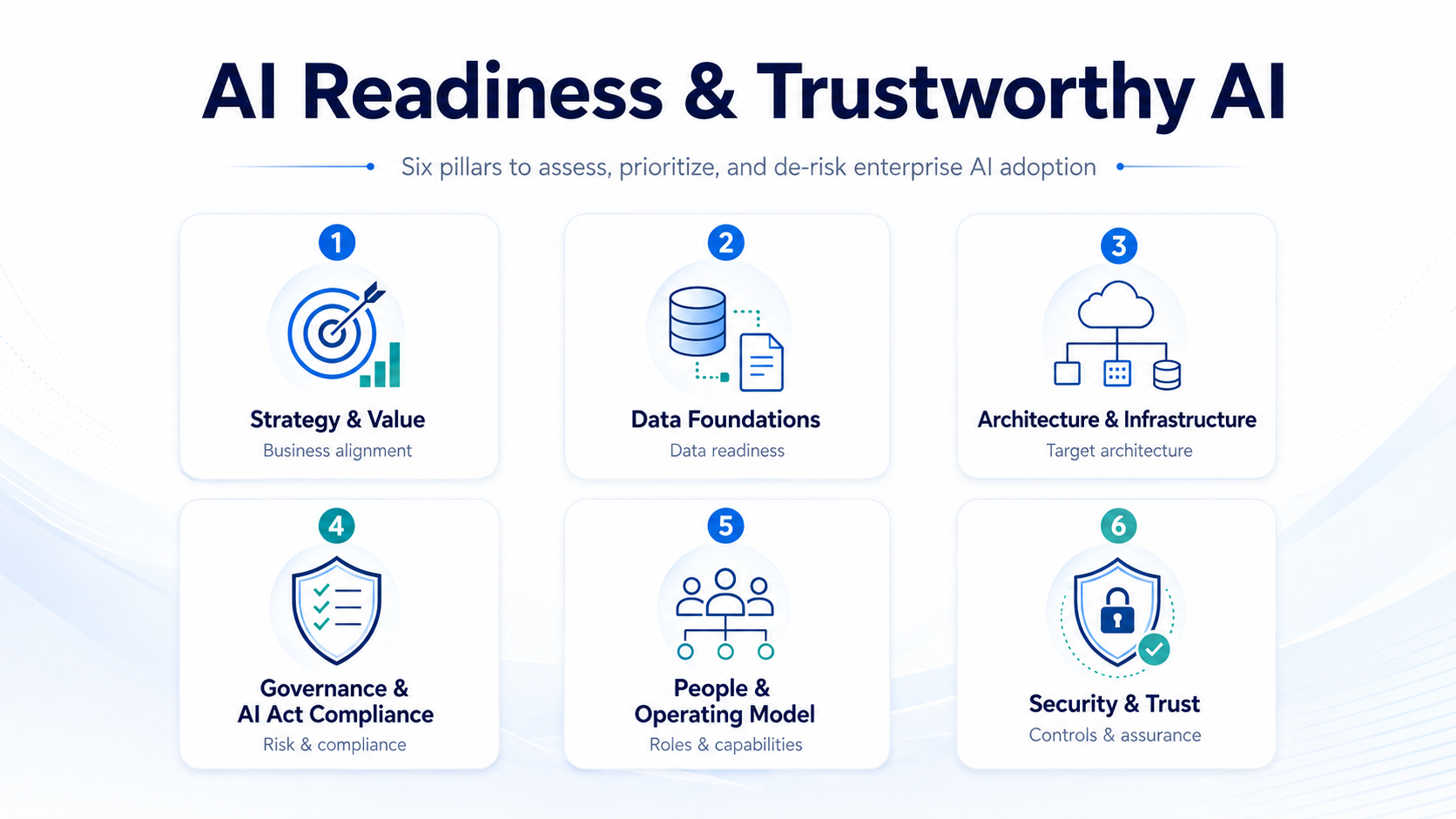
This is the first of six articles, one per dimension of the Mentis READY Framework — the six things we assess when an organisation asks "are we ready for AI?" Each article ends with the same offer: four minutes to find out where you stand.
The pattern we keep seeing
The conversation usually starts the same way. The board has asked for "something with AI". Three vendors have presented three different things. Somebody ran a ChatGPT experiment that impressed everyone and changed nothing about how work gets done. Legal has said no to the one idea that had a sponsor. And the question that reaches us is: where do we even start?
After twenty years of putting machine learning into production — long before the current wave — and a few dozen organisations later, the answer has become boringly consistent. Organisations rarely fail at AI for lack of technology. They fail because nobody decided what AI was for, nobody owned it, and nobody ranked the ideas before spending on them. That is the Strategy & Value dimension, and it is the first of the six for a reason: weakness here turns every other investment into an expensive pilot.
What "AI strategy" actually means (and what it does not)
It does not mean a slide deck with the word "transformation" on it. It means three concrete things exist and are written down:
- A position. What AI is for in this organisation over the next two to three years — cost, speed, quality, risk, new offerings — and, just as importantly, what it is not for yet.
- A portfolio. A short, ranked list of use cases, each scored on value, feasibility and risk, with a named business owner. Not a wish list: a portfolio someone can fund.
- An owner. One executive with the mandate and the budget, and a forum where AI decisions are taken. "IT, by default" is not an owner; it is an absence of one.
If those three things exist, the rest of the readiness picture — data, architecture, governance, people, security — has somewhere to attach itself. If they don't, the other five dimensions become a list of things to worry about rather than a plan.
The five maturity levels of Strategy & Value
We score every dimension on the same five-level scale. For Strategy & Value, the levels look like this:
| Level | What it looks like in practice |
|---|---|
| 1 · Ad hoc | AI comes up in conversations. No written position, no owner, no list. Decisions are made tool by tool. |
| 2 · Experimenting | Some teams experiment; ideas exist on a slide; IT evaluates informally. No shared direction or budget. |
| 3 · Structured | A written AI ambition exists; an interested executive carries it; use cases are scored, at least on value. |
| 4 · Managed | An approved roadmap with budget and sponsors; a portfolio ranked on value × feasibility × risk; a named owner. |
| 5 · Optimised | AI objectives carry KPIs reviewed at board level; the portfolio is managed with ROI tracking and retired ideas. |
Most mid-market organisations in Belgium and Luxembourg we meet sit between 2 and 3 — and, importantly, they often sit higher on technology than on strategy. They have a data team, a cloud, even a working model, and no decision about what it is all for. That inversion is the single most common reason a pilot never reaches production.
Three questions that tell you where you are
You do not need an assessment to get a first read. Answer these three honestly — they are the same three we ask in the scorecard:
Where does AI sit in your strategy? If the honest answer is "nowhere specific", you are at level 1 or 2, regardless of how many tools are in use. If a written ambition exists but nobody has resourced it, you are at 3 — and that is where most stalls happen, because ambition without budget produces pilots.
How do you choose AI use cases? "We haven't identified any" and "there is a list of ideas" are levels 1 and 2. The jump to 4 is a scoring discipline: each idea rated on value (what it is worth if it works), feasibility (data, integration, skills) and risk — including, since 2024, its EU AI Act risk class, because a high-risk classification changes the cost and timeline of a use case before a line of code is written.
Who owns AI at executive level? Nobody; IT by default; an interested executive informally; a named owner with a mandate; an owner plus a steering committee with decision rights. Read that list again and notice how far "an interested executive" is from "a named owner" — that gap is where compliance objections and budget disputes go to die.
The opportunity map: the one artefact that changes the conversation
The deliverable that does the most work in this dimension is a single page: the scored opportunity map. Every candidate use case on two axes — value and feasibility — with risk shown as colour and the AI Act class written next to it.
Three things happen when a leadership team sees this page for the first time.
First, the loud idea usually moves. The use case the board keeps mentioning often scores high on value and low on feasibility, because the data behind it does not exist in usable form. Seeing that plainly is worth the exercise on its own.
Second, quiet winners appear: the document-processing or knowledge-assistant use case nobody pitched, high on feasibility, decent on value, minimal-risk under the AI Act — the kind of thing that ships in a quarter and buys credibility for the harder ones.
Third, the risk colouring forces the compliance conversation early, where it is cheap. A use case that classifies as high-risk is not forbidden; it is a project with documentation, oversight and logging duties built in — and knowing that at selection time, rather than at go-live, is the difference between "legal blocks everything" and "legal signed off in week two".
What to do in the next 30 days
If you recognise yourself at level 1 to 3, do not start with a vendor. Start with three moves that cost little and change a great deal:
- Name an owner. One person, with a mandate to say yes and no. A committee of enthusiasts is not ownership.
- Build the list, then score it. Collect every AI idea in the organisation — there are always more than leadership knows — and score each on value, feasibility and risk (the free AI Opportunity Finder hands you a first candidate in six questions). Be ruthless about feasibility: "do we have this data, clean, accessible, with rights to use it?" kills half the list, and that is the point.
- Pick one thing and a metric. The highest-feasibility use case with real value, a success metric agreed up front, and a fixed-scope pilot on your real data. Not the most exciting idea — the one most likely to ship.
If you do only that, you move from 2 to 4 in a quarter without buying anything.
Where this sits in the bigger picture
Strategy & Value is one of six dimensions. The next articles cover Data Foundations (why "our data isn't ready" is usually half true and fixable), Architecture & Infrastructure (including the sovereign, on-premise path for organisations that cannot send data to US clouds), Governance & EU AI Act compliance, People & Operating Model, and Security & Trust. Together they produce the maturity radar we use in the AI Readiness Assessment — a four-week, fixed-price diagnostic for mid-market organisations in regulated sectors.
Want a first read now? The free AI Readiness Scorecard asks the three questions above — and fifteen more across the other five dimensions — and gives you your maturity radar in four minutes. No account, no sales call attached; if you want a second opinion on your results, leave an email and we will write back within a business day.
Mohamed Ben Haddou is the founder of Mentis Consulting (Brussels, ULB spin-off, since 2005) and an Independent AI Expert for the European Commission.